What's actually changing
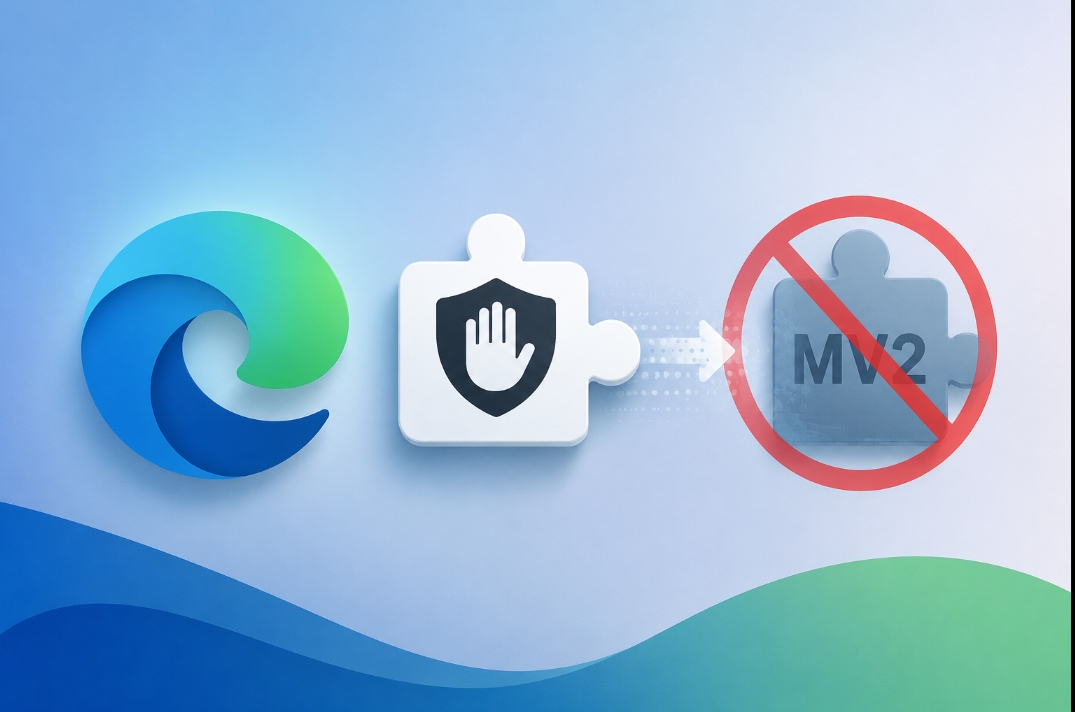
Browser extensions run on a manifest format that defines what an extension is allowed to do. Chrome, Edge, and every other Chromium-based browser have spent the past few years migrating from Manifest V2 (MV2) to Manifest V3 (MV3), a newer standard Google introduced primarily for security and performance reasons. The practical effect for ad and content blockers is that MV3 replaces the flexible webRequest/blockingWebRequest application programming interface (API), which let an extension inspect and rewrite network requests as they happened, with declarativeNetRequest, a more restricted API that requires blocking rules to be declared in advance rather than decided on the fly.
Microsoft confirmed on August 7, 2026 that Edge will start retiring MV2 extensions for regular users this month, rolling the change out first through the Canary channel, then Dev, then Beta, then Stable, with the consumer-facing phase-out targeted to finish by the end of 2026. Enterprise deployments get more runway, with deprecation there not beginning until early 2027.
The scale of what breaks
Microsoft's own figures put the disruption in context: 95% of the most-used MV2 extensions in the Edge Add-ons store have already migrated to MV3. Only 58 MV2 extensions with meaningful usage remain on the old format, and of those, just three have no MV3 replacement available at all.
uBlock Origin, in its full form, is one of the three. Its creator, Raymond Hill, has built uBlock Origin Lite as an MV3-compatible fallback, but Lite drops capabilities the full version relies on, including on-the-fly custom filter editing and the deeper request inspection that blockingWebRequest made possible. Once Edge's rollout reaches a given install, users will see in-app notices on the Manage Extensions page and in the Add-ons store before their MV2 extensions are disabled by default.
Firefox draws a line
Mozilla addressed the situation directly on August 14, 2026, posting that "our support for uBlock Origin isn't going anywhere." The statement came as Edge's phase-out made Firefox, in practice, the last major browser still offering full support for the extension - Firefox has kept the older blockingWebRequest capability available alongside the newer declarativeNetRequest API, rather than retiring it, which is the technical reason uBlock Origin's full feature set still works there. The post drew heavy attention in developer circles, topping Hacker News' front page the same day.
Every other mainstream browser has now aligned with Google's MV3-only direction on this point, since Chrome, Edge, Opera, Vivaldi, and Samsung Browser are all built on Chromium and inherit its extension platform decisions. Brave, also Chromium-based, has said it will keep supporting the fuller blocking capabilities regardless.
Why the API distinction matters, not just the extension
The uBlock Origin story gets attention because it's the most visible casualty, but the underlying issue is broader than one extension. Any tool that needs to inspect network traffic in real time - privacy tools, some corporate security extensions, request-modifying developer tools - runs into the same declarativeNetRequest ceiling that content blockers do. Google's argument for MV3 has consistently been that the older API's power came with security and performance costs, since an extension with full request-interception access can also see and alter traffic in ways that are harder to audit. Mozilla's continued support for both APIs is a bet that keeping the more capable option available is worth the trade-off Google decided against.
A pattern beyond Edge
Edge is following a path Chrome already opened up, since both share the same Chromium extension platform and the same Google-set MV3 timeline. What makes Edge's rollout worth tracking on its own is the concrete numbers Microsoft has published - a 95% migration rate against a short, named list of holdouts - which is a more precise picture of the transition's real-world impact than "extensions will eventually change" statements typically offer. It also confirms that uBlock Origin's situation isn't a Chrome-specific quirk being worked around elsewhere; it is the shared consequence of the MV3 API surface across every Chromium-based browser, with Firefox's separate extension engine as the one exception.
What it means in practice
Edge users who rely on full uBlock Origin filtering should expect prompts to switch to uBlock Origin Lite or another MV3 extension as the rollout reaches their channel over the coming months, and should treat any MV2 extension still in daily use as worth checking against Microsoft's migration notices before it's disabled automatically. For anyone who wants to keep the deeper filtering uBlock Origin's full version offers without changing habits, Firefox is currently the only mainstream option that supports it without qualification. Developers building extensions that depend on request-level interception face the same choice on a longer timeline - Chromium's ecosystem is moving as one, and building against declarativeNetRequest now avoids a scramble later.